
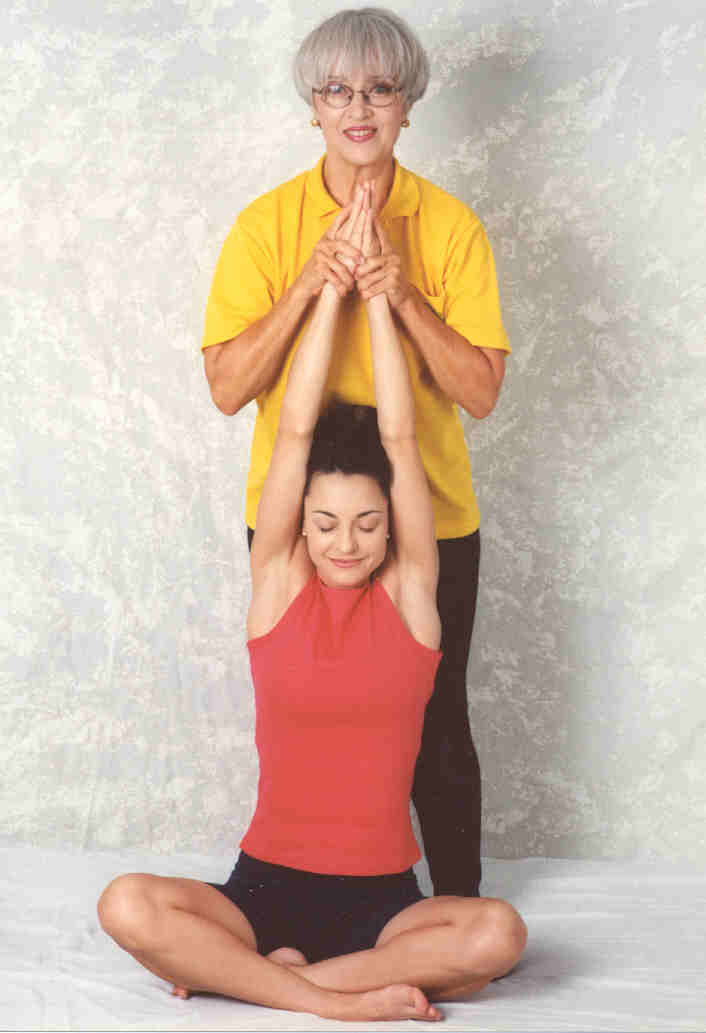
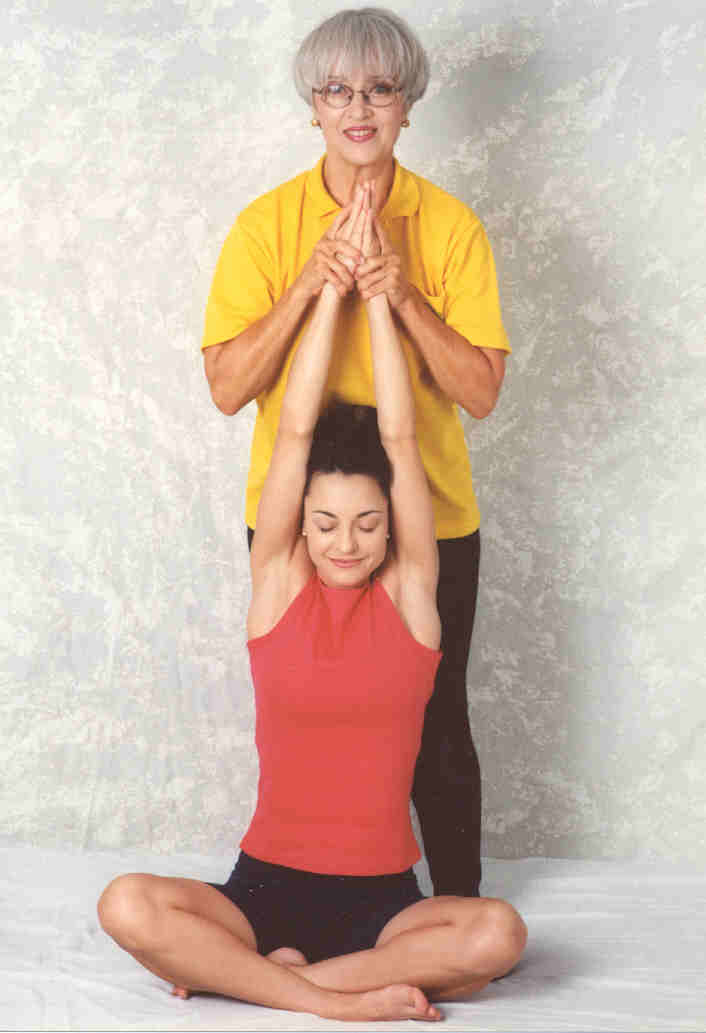
Winnie demonstrates the
standing arm stretch.
Thai Massage is probably the newest form of healing
work practiced in this country, yet it is one of the oldest forms
of developed medicine. It is very rhythmic and meditative, enabling
both the client and the practitioner to reach a deeper level of
consciousness. |
About
Thai Massage
History of Thai
Massage
Traditional Thai Massage, also called Nuad Bo-Rarn, is one of the
oldest forms of developed medicine. It has been taught and practiced
in Thailand for over 2,500 years. According to folklore, this ancient
practice originated in India thousands of years ago. Thai Massage
is believed to have come from Jivaki Komarbhacca, who is still referred
to as the “Father Doctor.” He was a physician, friend
and contemporary of Buddha.
Philosophy of Thai Massage
Rooted in the Indian Ayurvedic medical practice, Thai Massage is
one of many forms of Oriental bodywork based on energy balance theory
of health and healing. The Chinese system of acupressure is an obvious
influence. Thai massage focuses on the ten major sen lines by palming
and thumbing along these energy pathways. According to this theory,
the human body contains a field of energy within it composed of
72,000 sen lines, ten of which hold top priority. The Chinese meridian
theory calls this energy “chi” and the Indian Ayurvedic
system of nadis refers to it as “prana”. It is believed
that blockages in the flow of this energy manifest in discomfort,
disease and pain. Most ailments then are the result of an imbalance
in these meridians, whereas free flow along the sen lines leads
one to feel energetic, relaxed and free from stiffness and pain.
Working pressure points along the sen lines releases blockages of
energy and increases energy flow, thereby helping to restore balance,
the key to good health. Well-being can be restored and maintained
by rhythmically working along the ten sen or vital energy conduits.
This sacred philosophy was taken directly from the teachings of
Yoga. Thai Massage is very rhythmic and meditative, enabling both
the client and the practitioner to reach a deeper level of consciousness.
Practice of Thai Massage
The Thai Massage form of body therapy includes therapeutic stretching,
joint mobilization, rhythmic deep-tissue compression, toning of
energy lines, acupressure, assisted hatha yoga poses, mindfulness
and loving-kindness meditation. Due to the unique form of stretching
employed, Thai Massage is sometimes called “lazy man’s
Yoga.” The practitioner is able to direct the intensity of
the stretching and pressure points for a much deeper result than
one practicing yoga on their own would be able to achieve. Movements
are flowing and harmonious, creating a deeply soothing yet energizing
effect for both giver and receiver. It is practiced on a firm mat
on the floor. It involves peripheral stimulation, acting as an external
stimulant to produce specific, internal effects. The effective use
of the practitioner’s body weight is instrumental in the practice.
With the exception of the feet, the client remains fully clothed. |
How Thai Massage
Can Help You
• Increase and maintain range of motion
in the joints.
• Relieve muscle soreness. Light exercise promotes a better
supply of blood and oxygen to the muscles.
• Help decrease unnecessary neuromuscular tensions by promoting
general relaxation and reducing emotional stress.
• Elongate and release the fascia (the muscle’s binding
and support system). Elasticity varies between individuals.
• Increase tissue temperature by increasing the metabolic
rate through positive and
progressive stress.
• Help provide greater potential of physical and athletic
skills.
• Relieve muscle/joint stiffness associated with the aging
process.
• Help prevent joint sprains, muscle strains and tears and
re-injury to previously traumatized joints and muscles.
• Reduce soreness, relax muscles and eliminate toxins by increasing
blood flow to fatigued areas as part of the warm-down process.
• Provide an important adjunct toward recovery during rehabilitation.
• Reduce tightness that may contribute to pain, spasms or
cramping.
• Increase muscular tendonous extendibility. |